
 Portable EV Charger
 Home EV Wallbox
 DC Charger Station
 BESS Charging Station
 V2G V2H V2V V2L
 EV Charging Module
 DC Charging Connector
 EV Accessories
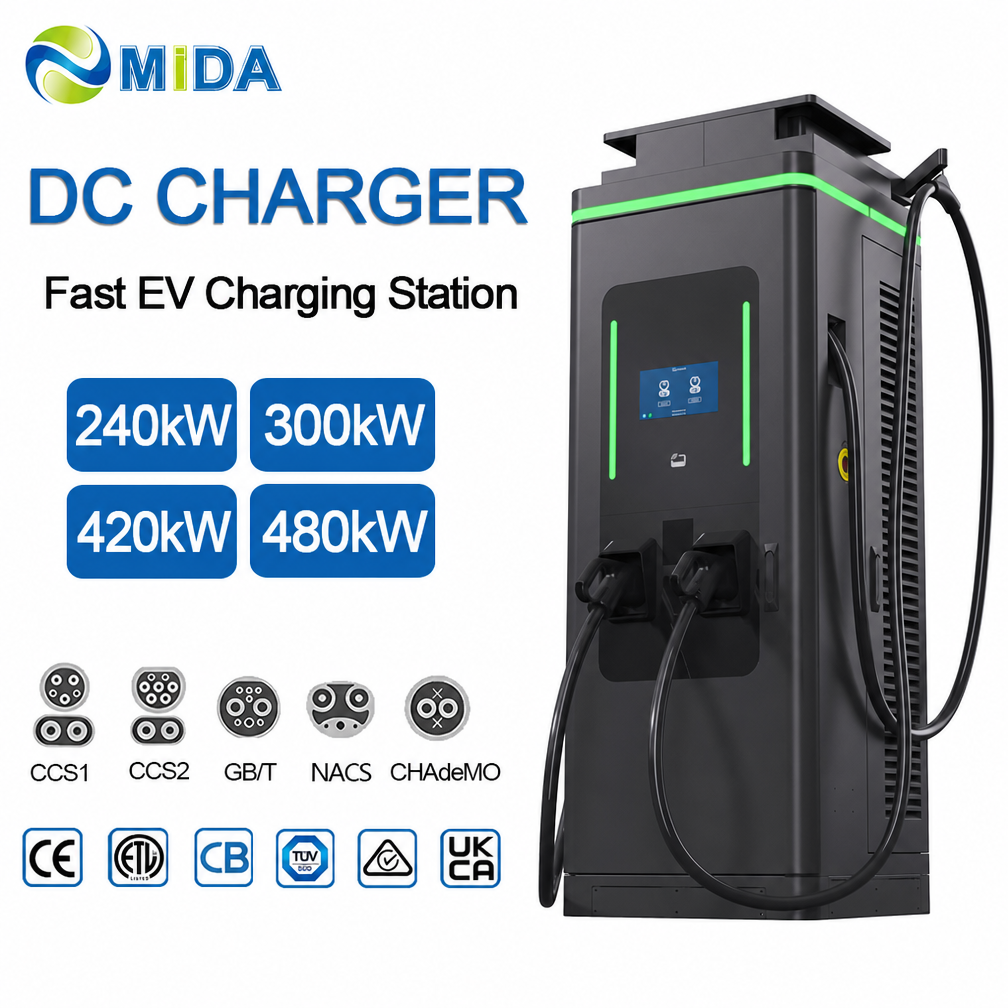
At present, searching for relevant charging pile interface pictures or documents online is either scattered or several years ago. This article summarizes the latest interface documents and explanations based on global charging interfaces.
Communication Charging Interface
The IEC 62196-2 Type-1 connector is based on the SAE-J1772 standard and designed for single-phase AC power ranging from 6 to 32A, with a maximum charging power of 7.4 kW. The IEC 62196-2 Type-2 connector is specifically developed for three-phase AC power up to 63A, with a maximum charging power of 44 kW. The Type-2 connector can also be used for single-phase charging without the use of contacts L2 and L3. Therefore, it is easy to adapt between Type 1 and Type 2 plugs.
GB/T 20234.2 supports single-phase and three-phase charging in charging mode 3. Both ends of the GB/T charging wire use the same male connector as Type 2.
NACS uses connectors that are compatible with Tesla’s design and protocol. In addition, it also supports the IEC 61851 AC charging standard.
DC charging interface
The Combined Charging System (CCS) is an extension of the AC Type-1 and Type-2 plugs, designed to achieve high DC charging capacity and add two high-power contacts. Like AC charging, CCS also uses CP, PP, and PE pins and expands the plug through positive and negative contacts. In order to achieve advanced communication for intelligent charging, a power line communication (PLC) function has been added to the CP pin. Pin Description:
- (1) CP: Used for communication (control signal exchange) between electric vehicle charging equipment (EVSE) and electric vehicles (EV). EVSE provides a ± 12V 1kHz square wave signal between CP and PE lines, and EV can control charging by modulating the amplitude of this signal (PWM communication). CP also has security functions, and once the CP connection is interrupted, the charging process will be cut off.
- (2) PP: Used to prevent electric vehicles from moving when connected to charging stations. The electric car can only operate after unplugging the charging plug. In Type 2 connectors, the PP pin is also used to detect the current load capacity of the charging cable. In Type 1 connectors, this pin is used to manually unlock the plug.
The Japanese DC standard is based on the CAN bus and is only used in Japan until recently when some exported electric vehicles from Mitsubishi, Nissan, and Renault also adopted this standard.
Provide a charging power of up to 900 kW.
MCS is designed for DC charging within the 3.75MW range and is suitable for large battery electric vehicles such as heavy-duty vehicles. It has two communication lines independent of CE (charging enable) and ID (insertion detection). Its communication method and basic principle are based on the ISO 15118-20 standard, but using different connectors. The underlying communication of MCS follows the IEC 61851-23-3 standard, while its underlying communication follows the ISO 15118-20 standard.
Using connectors compatible with Tesla, supporting multiple communication protocols.
Post time: Sep-21-2026
